Franka Robotiq Source
CoRL 2026
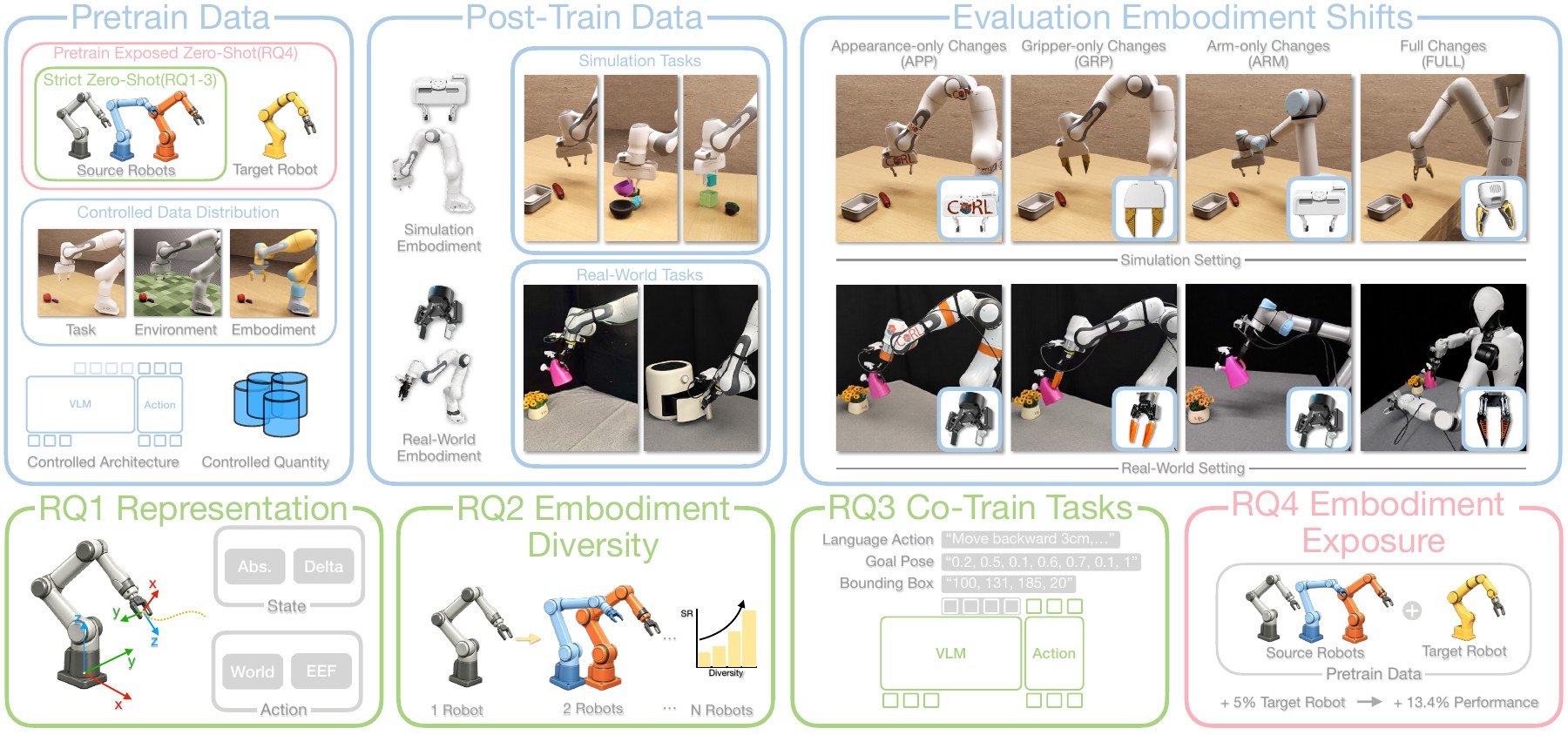
Zero-shot generalization to unseen embodiments is important for generalizable vision-language-action (VLA) models as robot hardware evolves and task-specific data collection remains costly. However, a systematic understanding of this problem remains limited, in part because the literature lacks a unified zero-shot transfer definition and controlled evaluation settings that isolate embodiment changes from differences in tasks, scenes, or protocols.
We distinguish strict zero-shot transfer, where the target embodiment is absent from all training data, from pretrain-exposed zero-shot transfer, where it appears only during pretraining. We introduce a controlled benchmark spanning 14 held-out target embodiments across simulation and real-world validation, then study state-action representations, pretraining embodiment diversity, auxiliary co-training objectives, and target-embodiment exposure.
Local end-effector state-action representations, the source-diversity comparison, and auxiliary co-training improve cross-embodiment transfer by around 15, 18, and 7 percentage points, respectively. Adding only 5% target-embodiment data during pretraining improves average target-embodiment progress by 13.4 percentage points, showing why strict and pretrain-exposed zero-shot transfer should be reported separately.
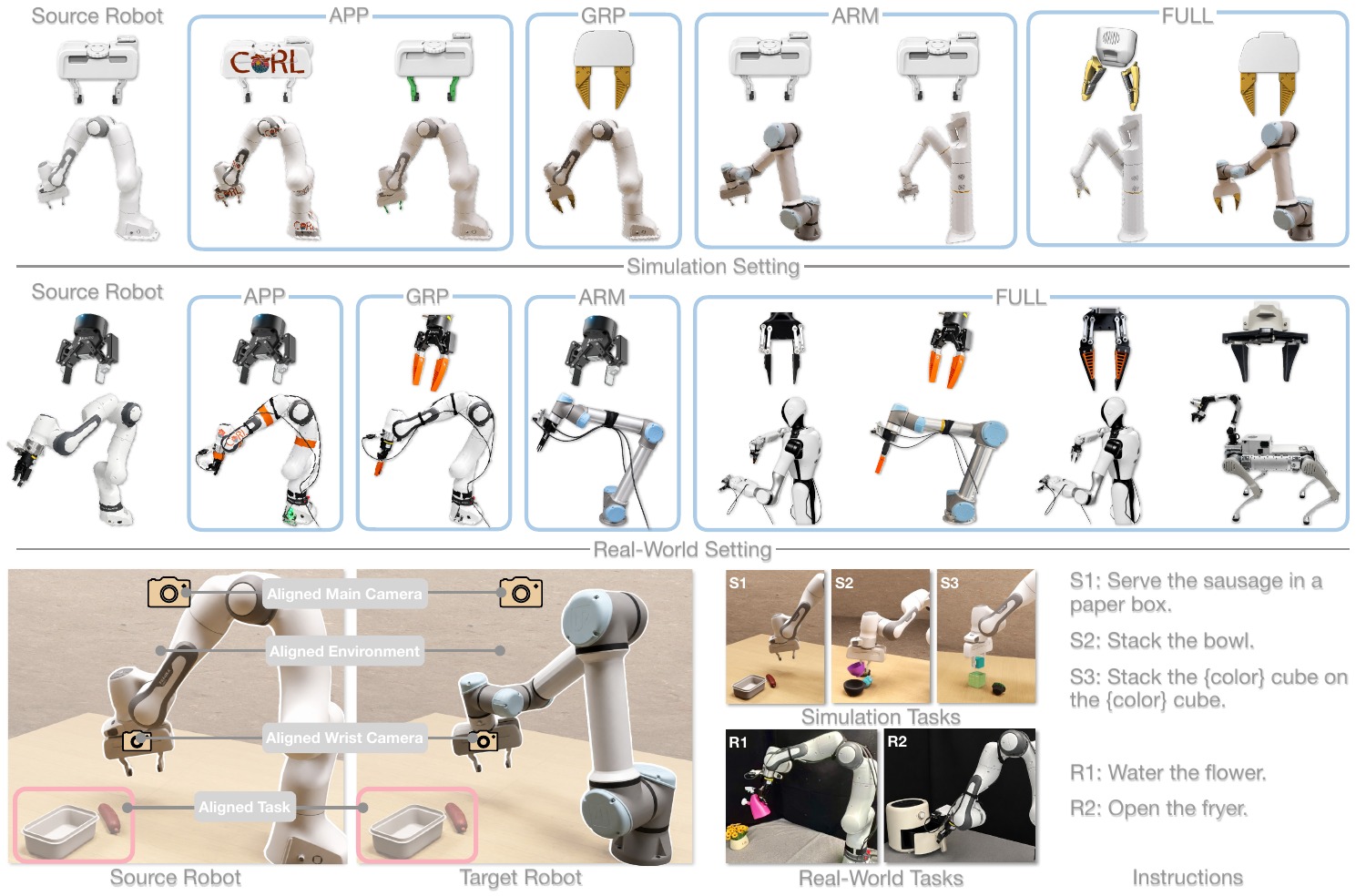
ZETA aligns tasks, object distributions, initial-pose regions, backgrounds, table layouts, lighting, and camera views between post-training and evaluation. The benchmark contains seven held-out simulation embodiments and seven held-out real-world embodiments, organized by the embodiment component that changes.
14
held-out target embodiments
6,300
simulation rollouts per model
140
real-world rollouts per model
4
controlled research questions
We compare absolute and delta end-effector states with world-frame and end-effector-frame delta actions. Local EEF-centered representations preserve more transferable motion structure as the robot morphology changes.
| State | Action | Simulation average | Real-world average |
|---|---|---|---|
| Abs. EEF | World-Delta | 60.3 | 56.0 |
| Abs. EEF | EEF-Delta | 64.6 | 61.6 |
| EEF-Delta | World-Delta | 73.4 | 60.8 |
| EEF-Delta | EEF-Delta | 75.7 | 89.9 |
Finding: EEF-Delta states and actions give the best average transfer in both simulation and real-world validation.
The main comparison fixes the total pretraining budget at 640K trajectories while varying the source pool from 1 to 8 to 512 embodiments. The 512-source setting outperforms the single-source setting, although the real-world 8-source result is non-monotonic as per-embodiment density falls before the source pool becomes sufficiently diverse.
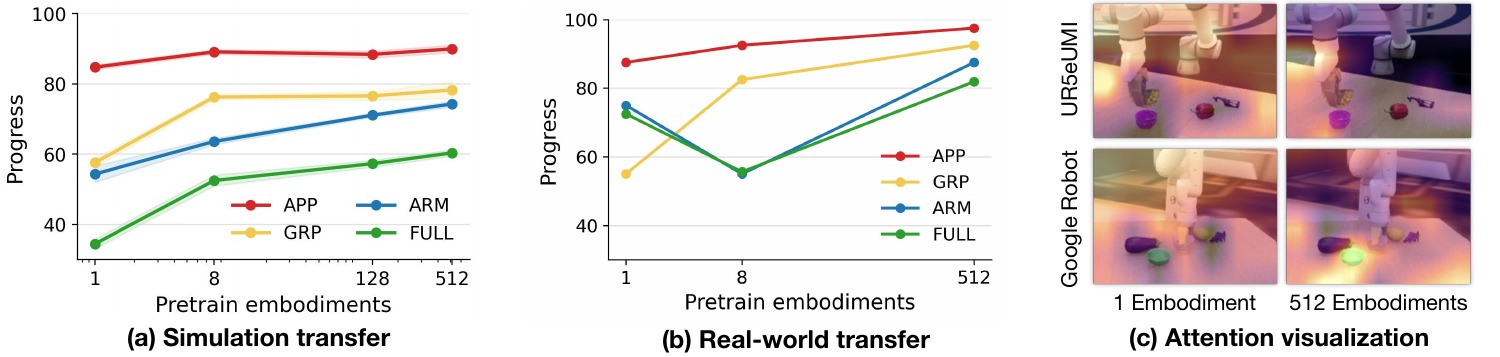
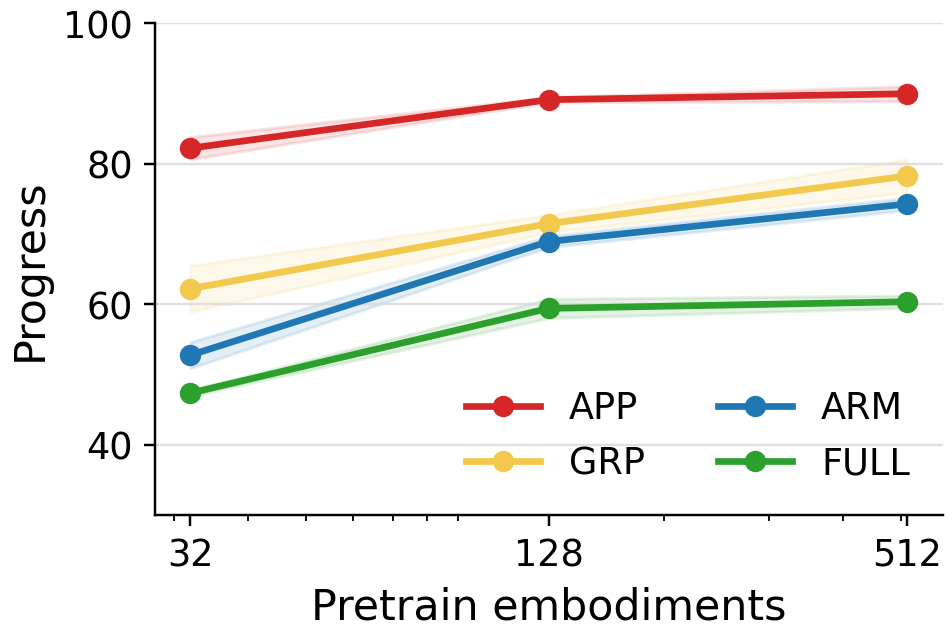
We also hold the trajectories per embodiment fixed while scaling from 32 to 128 to 512 sources. This complementary regime increases total data with source coverage; together, the two regimes provide complementary evidence rather than a complete causal isolation of diversity from data scale.
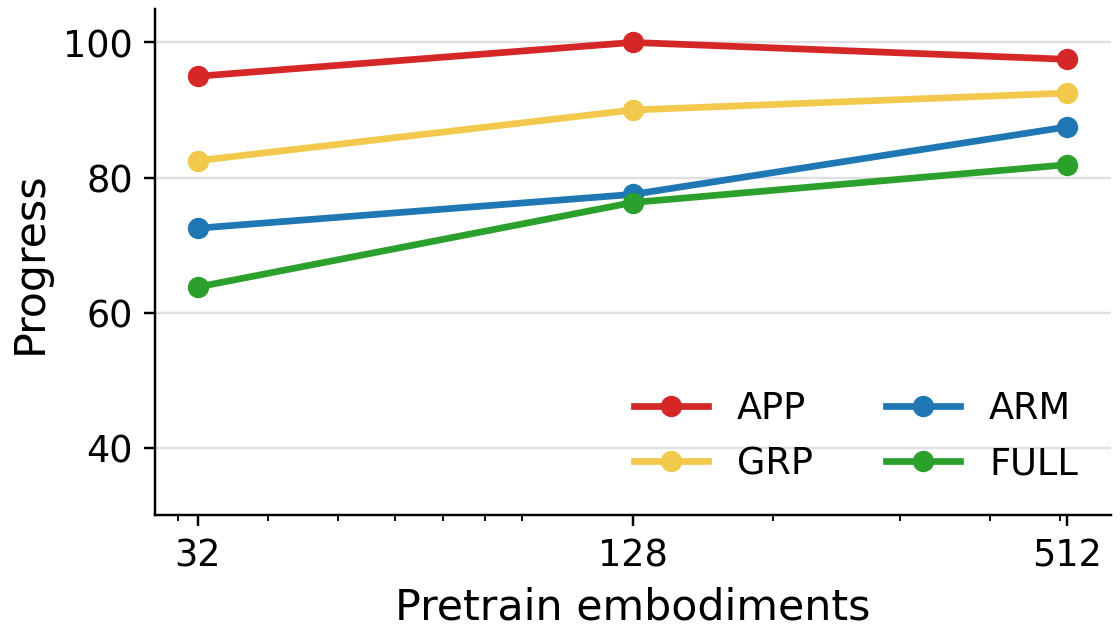
With the best RQ1 representation and the full 512-source pool, we test whether auxiliary objectives improve strict transfer beyond imitation-only training. Every evaluated co-training variant improves the average progress score.
| Post-training objective | APP | GRP | ARM | FULL | Average |
|---|---|---|---|---|---|
| No co-training | 90.0 | 78.3 | 74.3 | 60.4 | 75.7 |
| Language-action (EEF frame) | 88.6 | 86.7 | 79.3 | 70.5 | 81.3 |
| Language-action (both frames) | 88.6 | 79.8 | 73.8 | 68.4 | 77.7 |
| Subgoal | 90.3 | 87.4 | 77.8 | 71.5 | 81.8 |
| Task-conditioned bounding box | 90.2 | 87.0 | 80.1 | 71.9 | 82.3 |
Finding: task-conditioned bounding-box co-training raises average progress from 75.7% to 82.3%.
RQ4 replaces a controlled fraction of the fixed 640K pretraining budget with target-embodiment data while keeping target downstream tasks excluded. Even limited exposure changes the transfer difficulty, motivating separate reporting for strict and pretrain-exposed zero-shot settings.
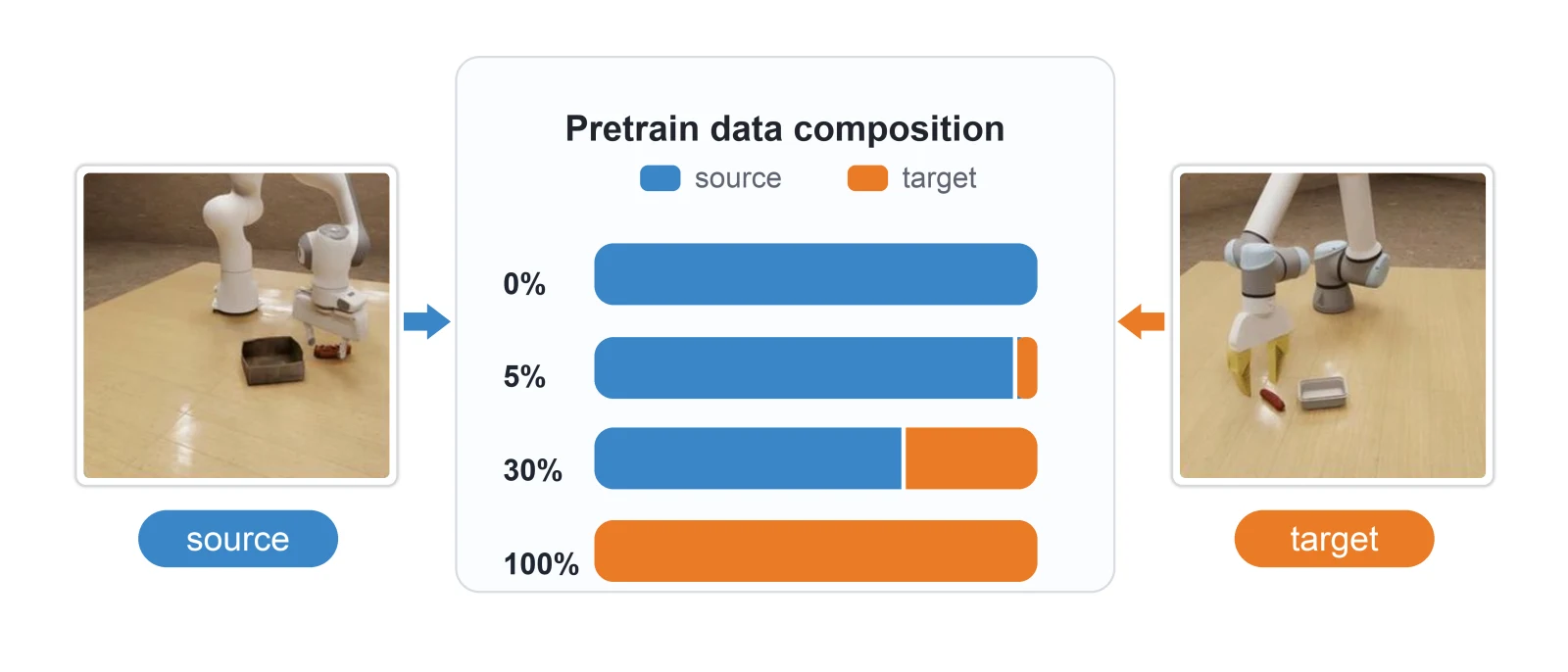
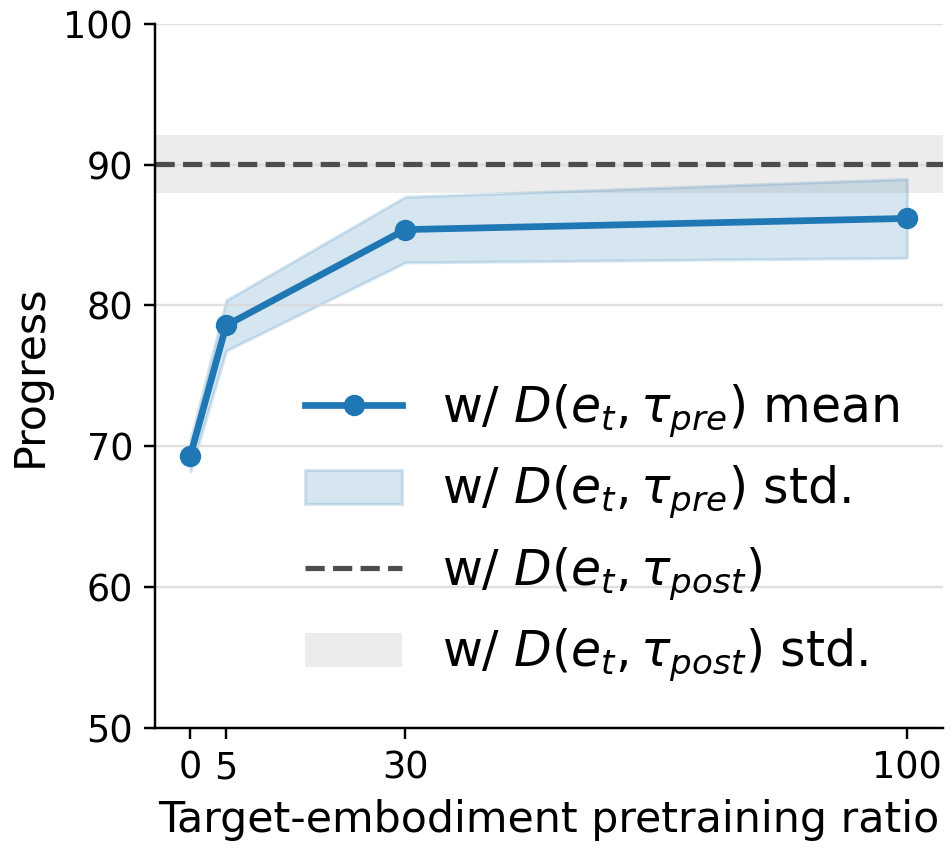
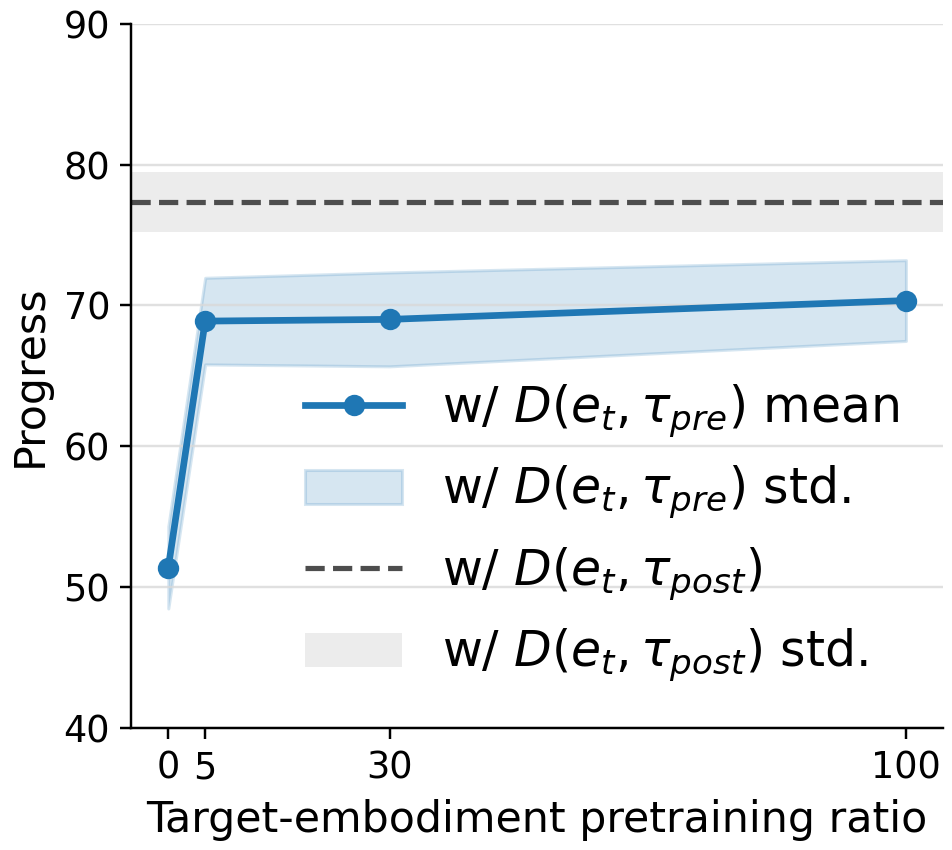
Finding: 5% target exposure improves UR5eUMI from 69.3% to 78.6% and GoogleRobot from 51.4% to 68.9%—13.4 percentage points on average.
Does target-embodiment exposure change which state-action representation transfers best? We compare all four RQ1 representations with 0% and 5% target-embodiment pretraining data. The total pretraining budget stays fixed, and target downstream tasks remain excluded.
| State | Action | 0% target (strict) | 5% target (pretrain-exposed) |
|---|---|---|---|
| Abs. EEF | World-Delta | 33.9 | 66.9 |
| Abs. EEF | EEF-Delta | 38.6 | 69.2 |
| EEF-Delta | World-Delta | 58.4 | 67.5 |
| EEF-Delta | EEF-Delta | 60.4 | 71.1 |
Finding: 5% target exposure improves all four representations and narrows the gap between the highest and lowest scores from 26.5 to 4.2 percentage points. EEF-Delta state and actions remain best, but representation choice matters most under strict transfer.
Franka Robotiq Source
Franka + CoRL sticker APP
Franka + UMI GRP
UR5e Robotiq ARM
UR5e + UMI FULL
Piper on quadruped FULL
Humanoid FULL
Humanoid + UMI FULL
Franka Source
Franka + green finger APP
Franka + CoRL sticker APP
Franka + UMI GRP
UR5e + Franka hand ARM
Google Robot + Franka hand ARM
UR5e + UMI FULL
Google Robot FULL
Simulation 1 source
Simulation 8 sources
Simulation 512 sources
Real world 1 source
Real world 8 sources
Real world 512 sources
Language-action +5.6 pp
Subgoal +6.1 pp
Task-conditioned BBox +6.6 pp
Google Robot 0% target
Google Robot 5% target
Google Robot 30% target
Google Robot 100% target
UR5e + UMI 0% target
UR5e + UMI 5% target
UR5e + UMI 30% target
UR5e + UMI 100% target